
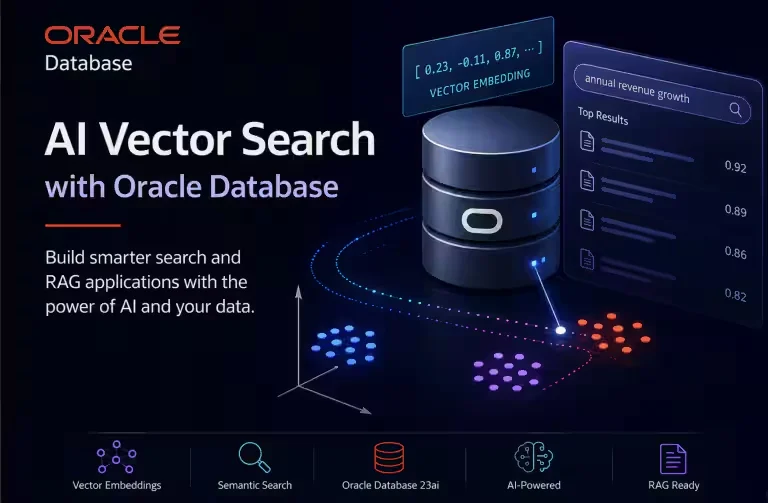
OCI Database AI Vector Search: A Practical Step-by-Step approach
Vector search is a retrieval technique that represents content as numbers in a high-dimensional space. These numeric representations are called embeddings. Text, documents, images, and other unstructured data can all be transformed into embeddings.
Once data is embedded:
Similar items appear closer together in vector space,
Dissimilar items appear farther apart,
A query can be converted into a vector and compared against stored vectors,
The database returns the nearest matches using a distance metric.
Instead of asking, “Does this row contain the same word?”, vector search asks, “Does this row mean something similar?”
Why Oracle Database AI Vector Search?
Oracle Database AI Vector Search is useful when we want semantic retrieval without moving data into a separate vector database. That gives you a few practical advantages:
Structured business data and unstructured content can stay together,
Similarity search can be combined with relational filters,
It helps to build hybrid search experiences that mix keyword and vector retrieval,
Workflow supports RAG-style applications, recommendation engines, document search, and image similarity use cases.
The usual Oracle workflow is straightforward:
Generate embeddings -> Store them ->index them -> Query them.
In newer Oracle AI Database releases, the VECTOR data type provides the foundation for storing embeddings alongside business data.
Before jumping into SQL, lets understand some fundamental parts:
Unstructured data becomes embeddings : A text chunk, product description, support article, or image is passed through an embedding model. The model converts the content into a vector: an array of numbers that captures semantic meaning.
The vector is stored in Oracle Database : Oracle stores the embedding in a VECTOR column next to the original business data. This keeps the source content, metadata, and semantic representation in one place.
A vector index accelerates retrieval : A vector index helps the database find nearest neighbors efficiently. Oracle supports vector indexes for approximate similarity search, which is usually the right choice when you need speed at scale.
A query is vectorized too : At search time, the user query is converted into a vector using the same embedding model. The database compares that query vector with stored vectors using a distance metric.
The best matches are ranked : The database returns the nearest vectors, ordered by similarity. You can also combine this with standard SQL predicates, such as tenant filters, category filters, or date ranges.
As part of the use case I have opted an implementation plan for : “Document search for internal knowledge bases”
1: Prepare the source data
Suppose you have a table of documents:
document ID
title
body text
category
last updated date.
If the content is long, split it into smaller chunks before embedding. Chunking improves retrieval quality because search works better when each embedding represents one coherent idea.
2: Create the target table
Create a table that stores both the text and the embedding.
Copied to Clipboard
Error: Could not Copy
Copied to Clipboard
Error: Could not Copy