
Airis Labs and Oracle Cloud Infrastructure bring AI-enabled media exploitation to secure missions
Government and defense organizations are facing a growing volume of digital media in the form of user-generated content (UGC), which can contain critical mission insights. From mobile phone videos and livestreams to social media posts and drone footage, adversaries increasingly use online content to coordinate activity, spread propaganda, and influence behavior. But extracting intelligence from this unstructured media using disconnected tools and workflows can slow analysis during time-sensitive operations.
For mission owners, speed is only part of the challenge. Sensitive video, metadata, and derived intelligence often cannot be moved into generic SaaS environments or processed outside approved infrastructure. Airis Labs, powered by Oracle Cloud Infrastructure (OCI), helps agencies accelerate AI-enabled media exploitation while keeping analysis close to the data across secure, sovereign, and classified cloud environments. Airis Labs transforms authorized video, imagery, audio, text, and metadata into searchable, evidence-linked intelligence that analysts can review, verify, and act on while maintaining control over sensitive mission data.
Accelerating AI-driven insight through the Oracle Defense Ecosystem
The Oracle Defense Ecosystem brings together technology innovators to help strengthen the national security of the US and its allies, offering members access to Oracle’s expertise and experience. As a member of the Oracle Defense Ecosystem, Airis Labs relies on OCI to support secure and sovereign mission operations, helping organizations keep sensitive mission data protected, compliant, and operationally accessible.
Airis Labs on OCI brings customers AI-enabled media exploitation capabilities that can be deployed across the secure mission environments where government and defense teams operate. Together, Airis Labs and OCI can help agencies pursue faster media analysis without requiring sensitive mission data to leave trusted cloud boundaries.
Today’s threat environment is shaped by the way bad actors create, share, and weaponize digital content. Traffickers, extremist groups, and other threat actors can use online media to influence behavior and coordinate activity[1], which can amplify propaganda and serve as recruitment material. Even a short video clip can provide a variety of identifiers like spoken language, background objects, location, vehicles, visible text, activity patterns, time sequences, and other mission-relevant indicators, subject to each agency’s legal authorities and policies. Manually extracting these details with industry-standard tools could take hours or days. Analysts may need separate tools for character recognition, object detection, geospatial analysis, and more. In defense operations, this delay could limit mission effectiveness.
Media volume is outpacing traditional review
Traditional media exploitation is also typically fragmented in disconnected workflows, requiring data analysis from multiple, separate teams. These disconnected workflows can slow exploitation and make it harder to maintain context or connect events across time, place, and source. For instance, one team may work with video evidence and another team may have geospatial context. Without a shared way to index, search, and correlate media, important insights can remain buried in separate systems.
Airis Labs and OCI can help analysts gain quicker insight
Airis Labs can help analysts turn raw media into intelligence they can search, connect, and verify. Designed as a “video-first” platform, Airis Labs extracts audio, imagery, text, time sequences, and metadata from videos to help teams identify people, locations, objects, and more. Agencies can use this technology to extract information from UGC, as well as other forms of video from CCTV, body-worn cameras, dash cameras, and drones.
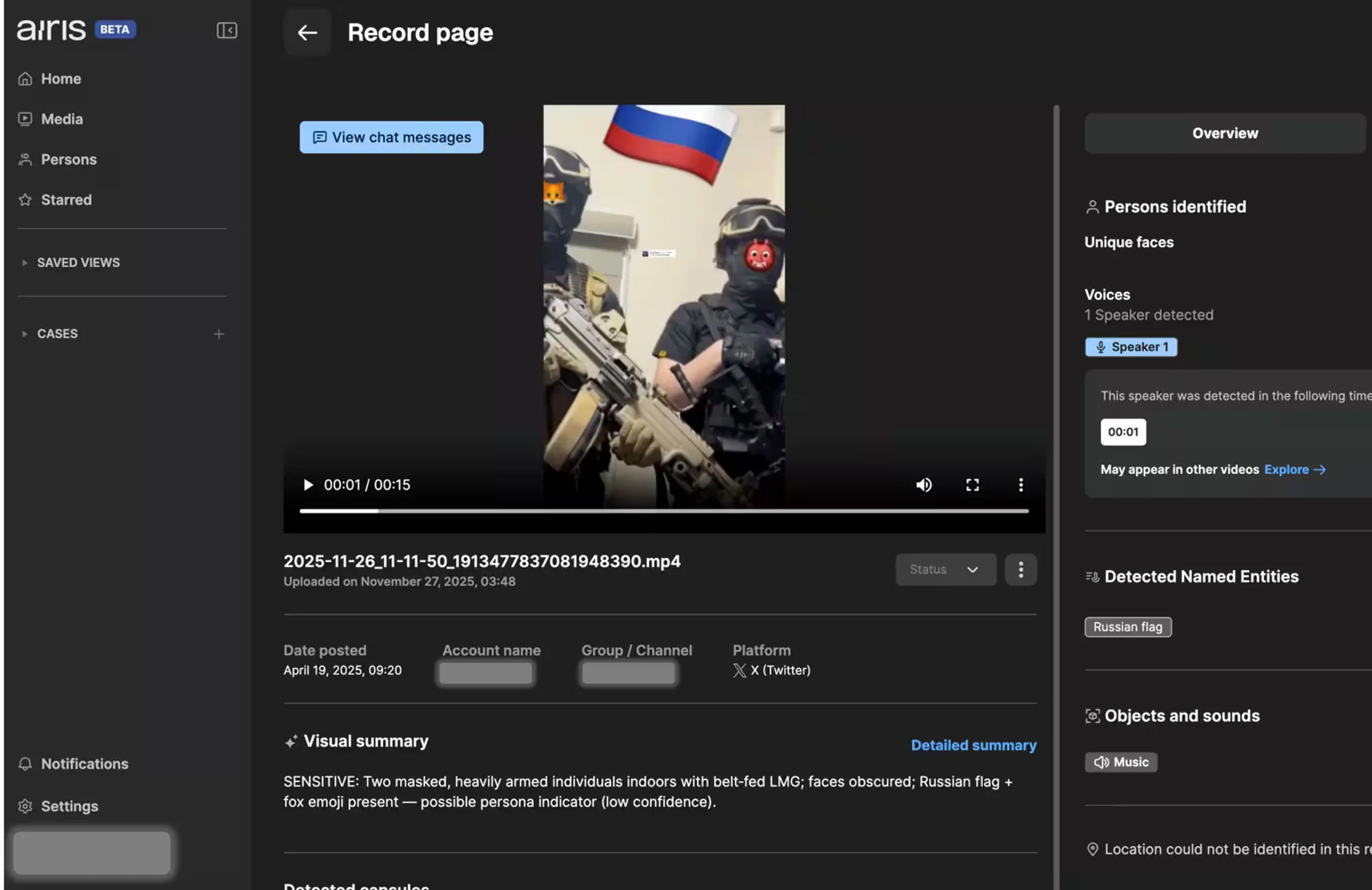
The following interface example shows how analysts can review AI-extracted intelligence in context, quickly validate each inference through a human-in-the-loop workflow, and intuitively traverse connected media, entities, metadata, and evidence in ways that were previously impossible.